

There is a particular kind of conversation that takes place at the intersection of haute horlogerie and high jewellery, a dialogue conducted not in words, but in carats, colour saturation, and the extremely hard labour of gem-setters whose fingertips know the difference between a commercial stone and a collector-grade one. Patek Philippe’s latest Nautilus gem-set offerings enter that conversation with characteristic authority.
Three References, One Vocabulary
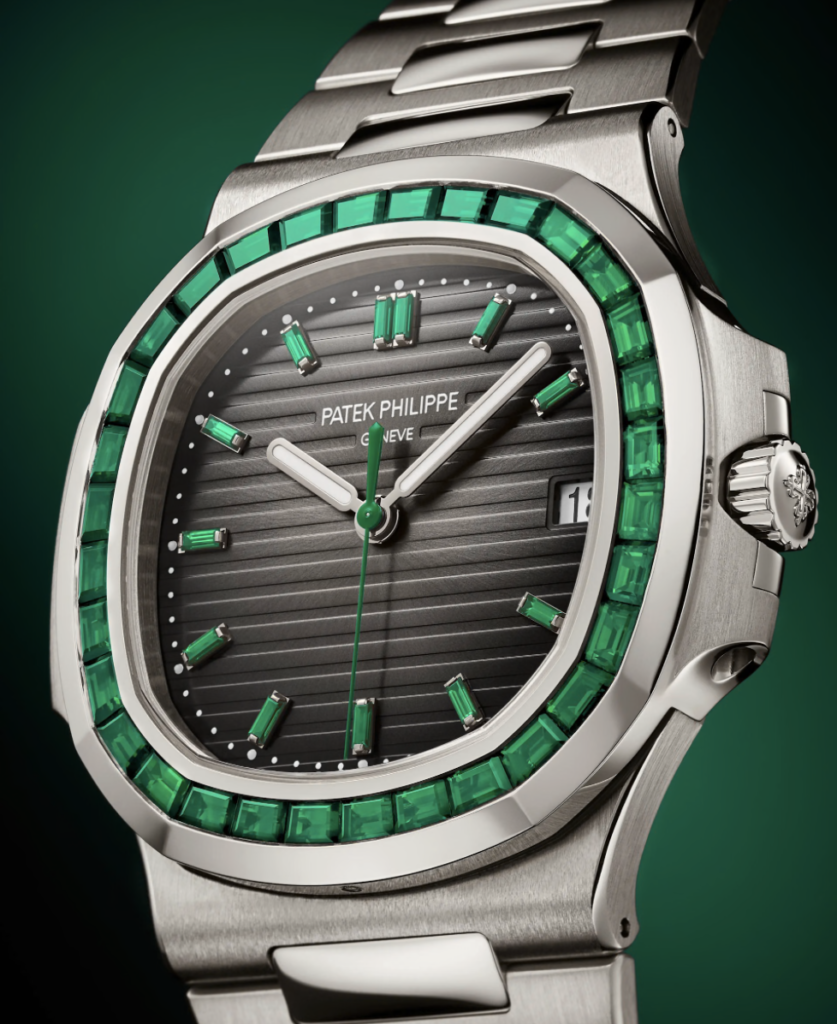
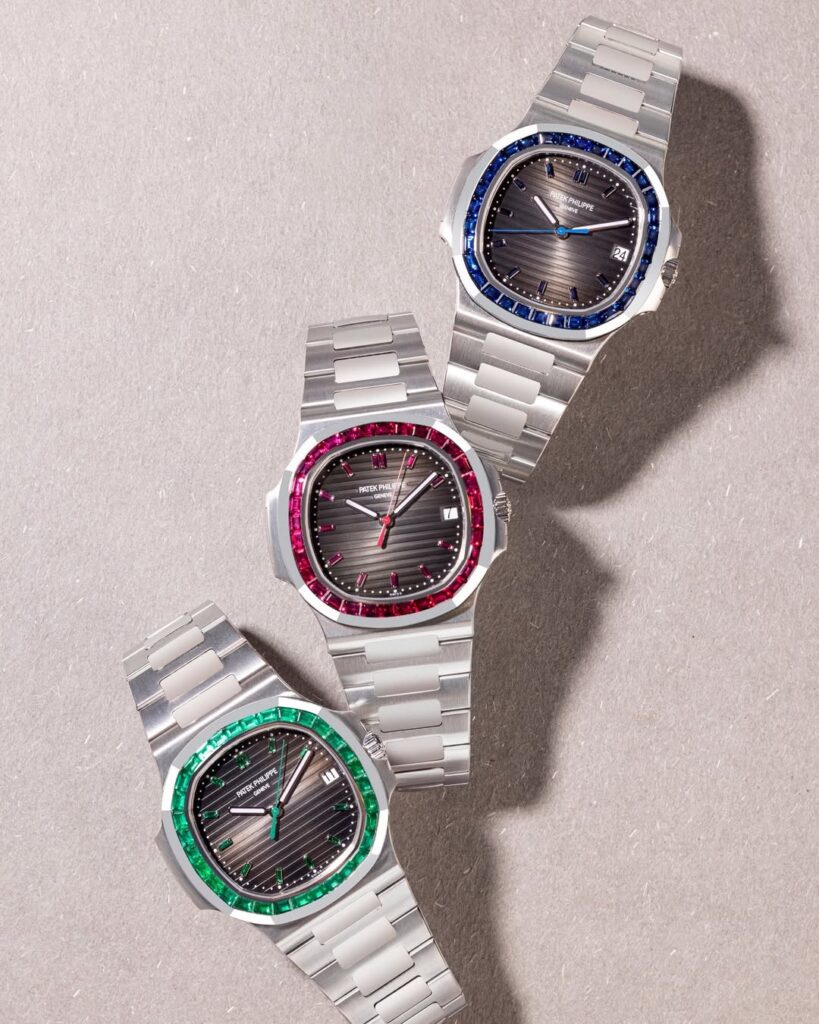
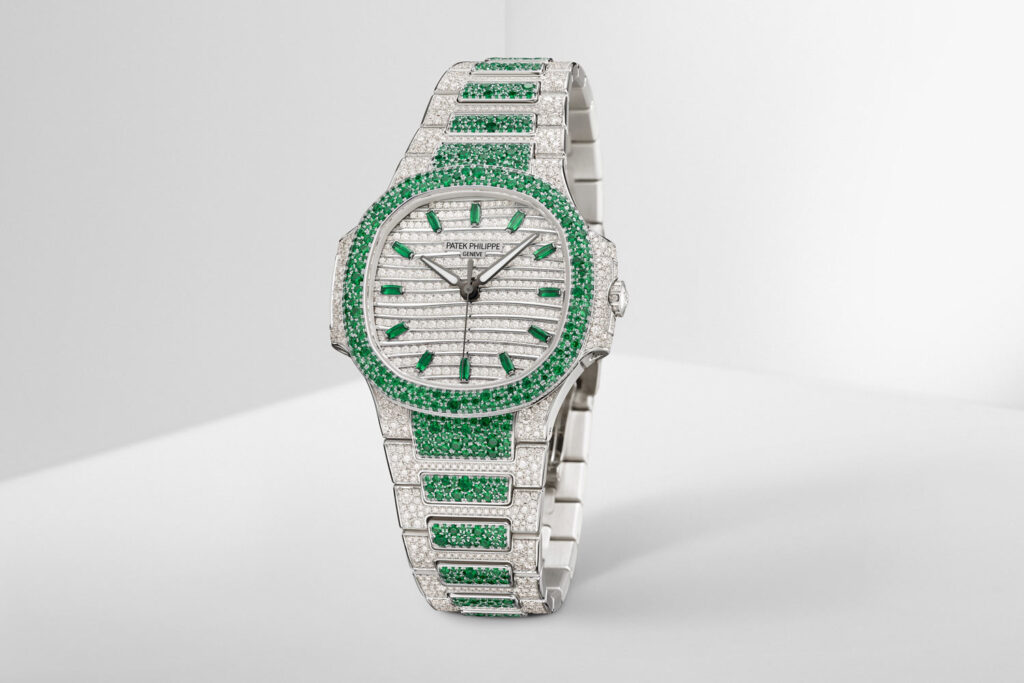
The three references under discussion could hardly be more different in character, yet they share the same three-stone vocabulary: sapphire, ruby and emerald. Reference 5711, the men’s Nautilus in platinum, presents gem-set bezels against the watch’s iconic dark horizontal-stripe dial, a restrained use of colour that lets the stone speak without overwhelming the watch. Reference 7118, the ladies’ counterpart in white gold, takes the opposite approach: an entirely pavé-set case and bracelet, stones running from lug to lug in one unbroken sweep of colour. Reference 5990, the Nautilus Travel Time Chronograph, goes further still: a fully set case and bracelet in white gold where coloured baguettes alternate with white diamonds, wrapping one of Patek’s most complex movements in an unbroken surface of stone.
The Price Hierarchy
The pricing tells a story that gemologists have understood for some time, though it often surprises those approaching luxury horology from the watchmaking side alone. Across all three references, the logic is consistent: sapphire is the entry point, ruby commands a modest premium, and emerald sits at a considerable distance above either.
In the 5711, sapphire opens at 255.000 €, ruby at 275.000 €, and emerald at 410.000 €, a gap of over 60 per cent between the first and the last. The 7118 follows the same order at a higher level: 530.000 € for sapphire, 535.000 € for ruby, and 610.000 € for emerald. The 5990, the most complex of the three references, takes the premium to another dimension entirely: 1.8M € for sapphire, 1.9M € for ruby, and 2.5M € for emerald. At that level, the gap between sapphire and emerald alone exceeds the total retail price of the 5711 emerald.
In every case, the stone drives the number. The movement, the metal, and the craftsmanship are constants. What changes is what grows in the ground.
Colombia Holds the Cards
Why? The answer lies partly in geology and partly in geopolitics, and the Colombians who control that supply chain know it better than anyone.
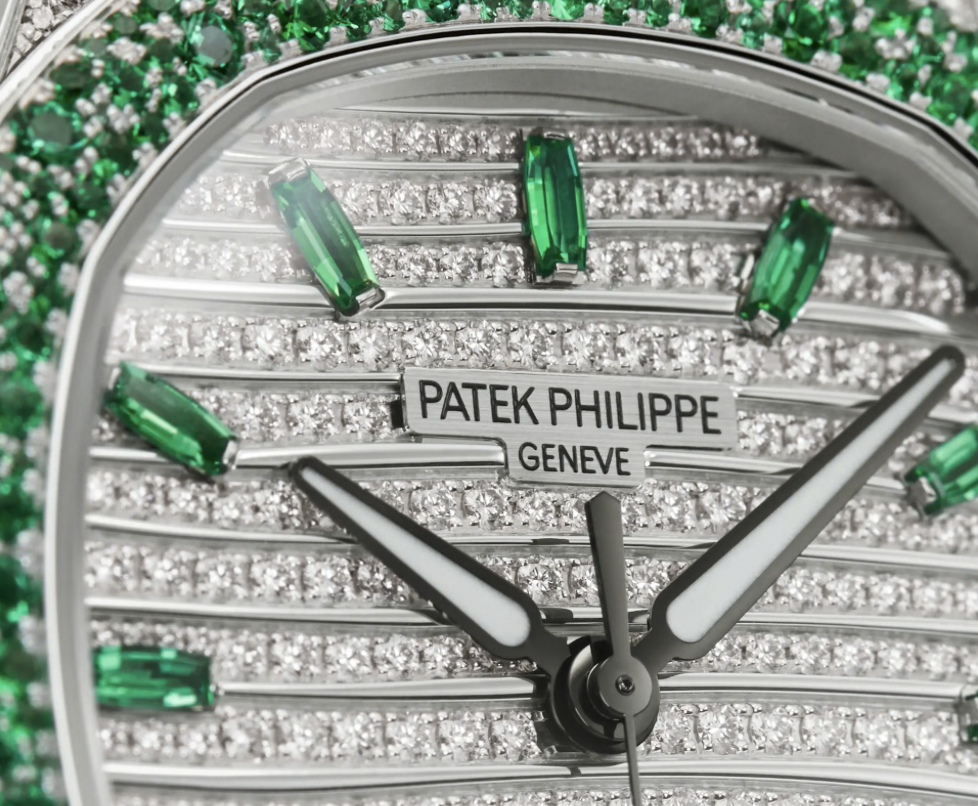
Colombia remains the world’s pre-eminent source of top-grade emeralds, and unlike producers of other coloured stones, the Colombian supply chain is acutely aware of the value it controls. The country’s miners, exporters, and middlemen do not, as a rule, undersell. They are sophisticated market participants who understand that a vivid, inclusion-free Colombian emerald of the size required for a Nautilus bezel is not merely a gemstone — it is a finite resource with an appreciating trajectory. Supply scarcity compounds the issue further. Top-colour emeralds have become genuinely harder to source in recent years — the supply simply isn’t keeping pace with demand.
Competing demand from Indian collectors, Chinese ultra-high-net-worth buyers and the majorEuropean auction houses means that Geneva’s gem buyers must now compete for parcels that, a decade ago, they might have secured with relative ease.
The Tsavorite Question
The pressures outlined above, scarcity, price volatility, and the growing difficulty of sourcing matched parcels of top-grade emerald—have quietly begun to reshape how the broader watch industry approaches green gemstones.
Tsavorite, the vivid green variety of grossular garnet, was first discovered in Tanzania and Kenya in the late 1960s.
In recent years, it has attracted increasing attention among mid- to high-end jewelry brands as a technically compelling and commercially more accessible alternative to emerald. At its finest, its color rivals that of Colombian emeralds, while its hardness surpasses them.
Crucially, while tsavorite’s supply chain is not without its own complexities, it does not carry the same geopolitical premium that Colombian emerald producers have spent decades embedding into their pricing structures.
For brands operating in the mid- to high-end segment, the logic is straightforward. At this price level, emeralds often require either a compromise in stone quality or a margin sacrifice that few commercial watchmakers can realistically sustain.
Tsavorite offers a compelling alternative: a gemstone that photographs beautifully, reads as genuinely precious, and avoids the need for constant negotiation with Bogotá each time a new collection enters production.
Whether this shift constitutes a downgrade is, of course, a matter of perspective. In purely optical terms, a fine tsavorite is a remarkable stone. But the watch industry does not operate on optics alone. It operates on heritage, narrative, and the kind of provenance that collectors scrutinize as carefully as they do dial finishing. Emerald carries centuries of history—from Mughal courts to European crown jewels—and that history forms part of what a buyer acquires when choosing the green variant over sapphire or ruby.
At Patek Philippe, this is not an active discussion. A manufacture that prices an emerald-set Nautilus at €2.5 million is not concerned with managing procurement costs through gemstone substitution.
For Geneva’s apex houses, emerald remains non-negotiable. Its scarcity and price are not problems to be solved, but arguments to be made.
Patek Philippe Nautilus ref. 5711
For the 5711 in particular, the challenge is further amplified by the bezel architecture itself. The Nautilus’s octagonal case requires baguette-cut stones of extremely precise calibration: each must be perfectly matched to the next in color, cut angle, and transparency, or the visual continuity of the setting is immediately compromised.
A single mismatched stone can compromise an entire bezel. By industry accounts, the rejection rate for stones that reach Patek Philippe’s atelier yet fail to meet final selection standards is exceptionally high.
Patek Philippe Nautilus ref. 7118
The 7118 presents a different, yet equally demanding challenge. A full pavé execution across a Nautilus bracelet involves thousands of individually set stones, each required to sit seamlessly alongside its neighbors, collectively forming a surface that, under ideal lighting, reads as a single, continuous field of color.
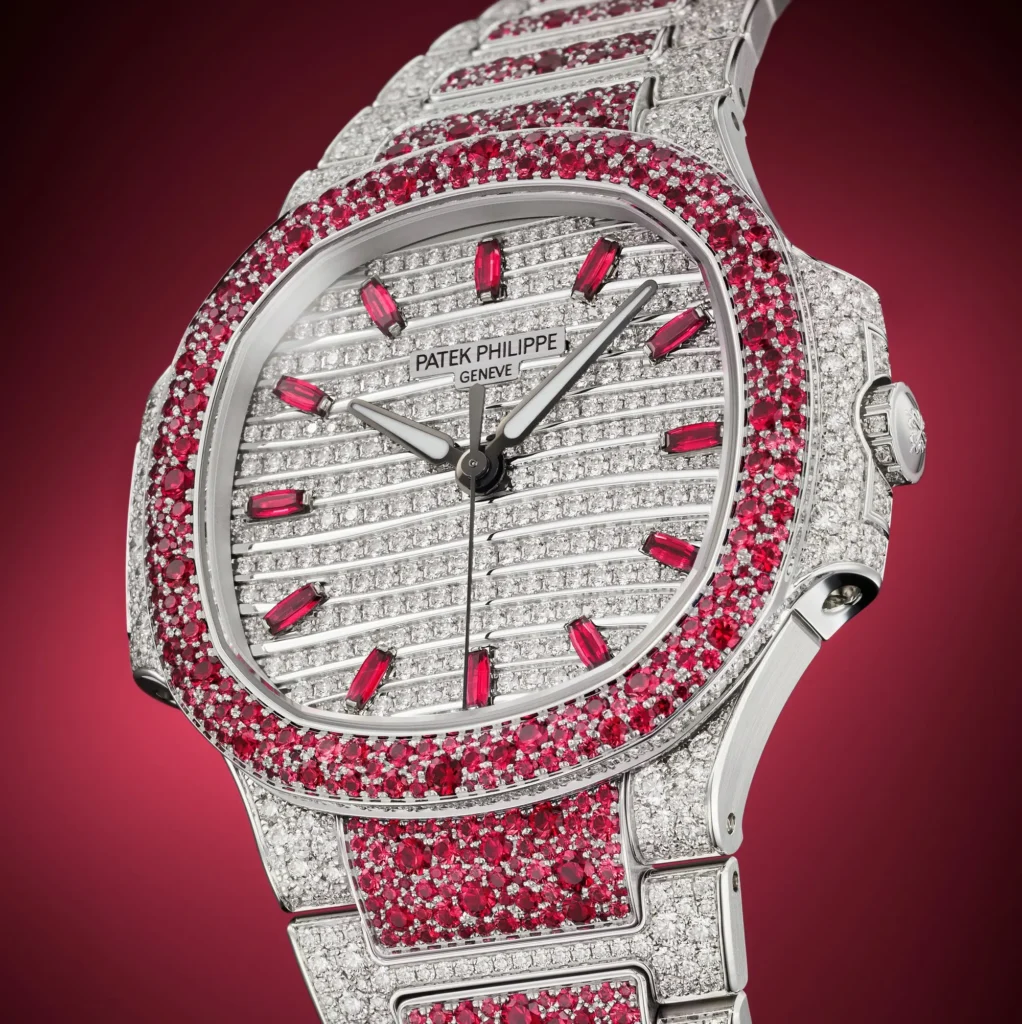
The technical achievement is remarkable in its own right. That Patek Philippe accomplishes this across sapphire, ruby, and emerald—three gemstones with distinctly different hardness levels and optical properties, each requiring subtly adjusted setting pressure—makes the result all the more impressive.
Patek Philippe Nautilus ref. 5990
If the 5711 and 7118 represent two distinct philosophies of gem-setting, the 5990 stands apart entirely: the point at which haute joaillerie meets haute complication.
The Nautilus Travel Time Chronograph is already among the most technically sophisticated pieces in Patek Philippe’s catalogue, combining a flyback chronograph with a dual time zone and day/night indication. Dressing it in baguette-cut colored stones across both the bezel and bracelet links is, by any standard, an extraordinary exercise in ambition.
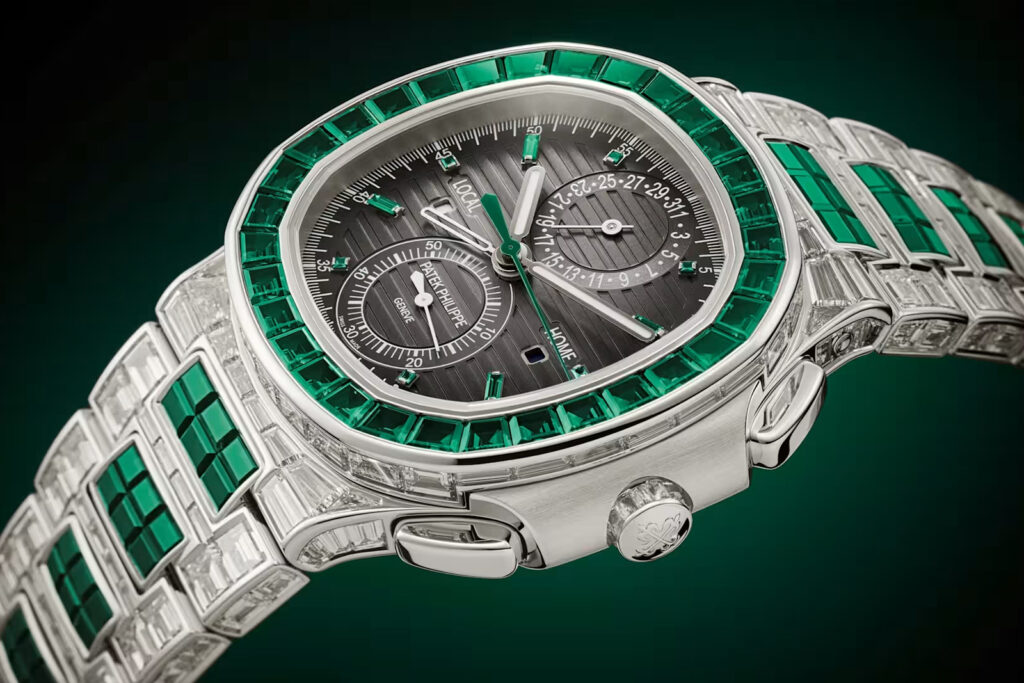
The pricing reflects this ambition without apology. Sapphire begins at €1.8 million, ruby at €1.9 million, while emerald—predictably—reaches the summit at €2.5 million, representing a premium of roughly €700,000 over its blue counterpart.
This gap is not solely a function of stone quality. It also reflects volume: a fully set 5990 bracelet requires a significantly larger parcel of matched baguette-cut stones than either the 5711 or the 7118. Sourcing such volume in top-grade emerald—where consistent color across dozens of individual stones is genuinely rare—constitutes a procurement challenge of an entirely different order.
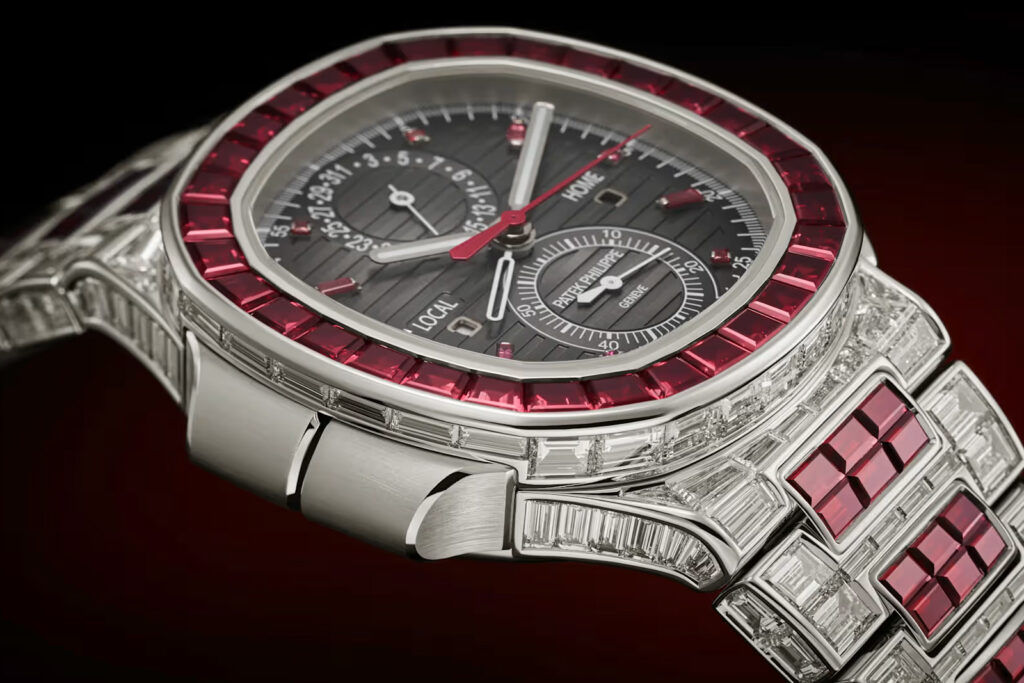
At €2.5 million, the emerald-set 5990 is not merely the most expensive watch in this catalogue. It serves as a reminder that when horology and gemmology converge at the highest level, the limiting factor is almost never the movement.
The Secondary Market: Where List Price Becomes a Floor
If official catalogue prices appear ambitious, secondary market data suggests they may, in fact, be conservative. Transactions recorded on platforms such as Everywatch tell a story that will surprise no one who has attempted to acquire one of these pieces through conventional channels—and likely astonish everyone else.
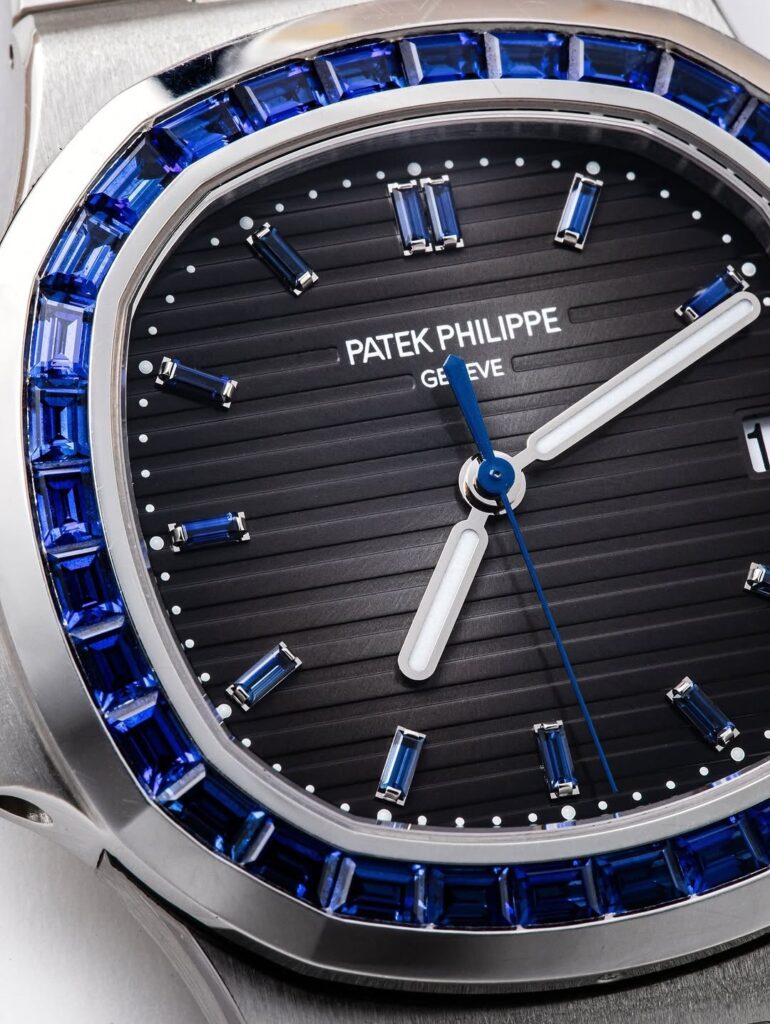
The 5711 emerald, listed at €410,000 by Patek Philippe, has traded on the secondary market at prices ranging from €650,000 to well over €1,650,000, depending on condition, provenance, and the buyer’s appetite at any given moment.
That upper figure, recorded by a Spanish dealer in December 2025, represents a premium of more than 300 percent over retail. Even the more measured transactions sit comfortably above €630,000, suggesting that the market floor has long since decoupled from anything Geneva originally intended.
The sapphire and ruby variants of the 5711 tell a similar story. Sapphire examples have sold at auction and through dealers at prices consistently between €550,000 and €725,000, against a retail price of €255,000. Ruby references have performed no differently, with recorded dealer transactions ranging from €675,000 to €780,000, compared to a list price of €275,000. In both cases, the secondary market is clearly pricing in a scarcity premium that effectively triples the manufacturer’s own valuation.
In practical terms, this means that the gem-set Nautilus has ceased to function as a watch purchase in any conventional sense. For those able to access it, it has become an exercise in asset allocation. The same scarcity that makes emerald so expensive to produce is precisely what makes it so difficult to acquire, and so compelling to hold.
Whether this dynamic is ultimately healthy for the long-term culture of watchmaking is a question the industry is only just beginning to confront openly.
Across the three references, what this catalogue ultimately reveals is that the Nautilus, conceived in 1976 as a bold statement on the value of steel, has evolved into an equally powerful statement on the value of colour. Sapphire, ruby, emerald: three stones, three price points, three distinct dialogues with the earth. Patek Philippe, for its part, is listening to all of them.
Follow us on our social media channels to stay up to date with the latest news from the world of watchmaking, and discover what’s new on Watchype.
