

The State of the Primary Market
In recent weeks, several industry reports have offered a clearer picture of where the watch market truly stands in 2025. The narrative is no longer simply about growth or crisis, but about redistribution, concentration, and strategic control.

According to the Morgan Stanley x LuxeConsult Swiss Watch Industry Report, the primary market recorded a contraction of 1.7% in value, bringing the total Swiss watch market to 49 billion CHF. This does not signal a collapse, but rather a normalization phase after the post-pandemic surge driven by suppressed demand. Growth is no longer automatic. Today, performance depends on supply discipline, pricing power, and the preservation of exclusivity.
China Slows, Hong Kong Remains Strategic
China declined by 9%, a significant figure considering its central role over the past decade. The domestic market has not yet returned to pre-Covid levels. However, Hong Kong continues to act as a crucial commercial hub for regional clients, confirming how fluid and geographically adaptable luxury consumption has become.
Market Concentration and the Rolex Effect
One of the most striking elements of the report is the degree of concentration at the top. Rolex dominates with a 32.9% market share. The brand reduced volumes by 2% while increasing its average selling price by 6%. This reflects a deliberate strategy. Rolex understands that increasing production might have generated higher short-term revenue, but at the risk of diluting exclusivity, a core principle of luxury economics.

Together with three other privately owned brands, Richard Mille, Patek Philippe, and Audemars Piguet, Rolex controls nearly 50% of the entire market. Four brands account for half of the industry’s value. This level of concentration represents not only financial power but also control over production, distribution, and brand perception.
Ultra-Luxury vs Accessible Luxury
The data clearly shows a growing polarization. Watches priced above 50,000 CHF represent 37.4% of total export value, despite accounting for only 1.4% of total volume. Ultra-luxury is performing strongly. More accessible luxury is under pressure.

High-net-worth individuals continue to spend, while the broader aspirational segment faces inflation, macroeconomic uncertainty, and shifting priorities. The middle tier of the market is becoming increasingly compressed, with brands either moving upward in exclusivity or struggling to defend their positioning.
Omega’s Shift in Ranking
Omega is now ranked fifth among the best-selling brands. For years, it consistently held second place behind Rolex. This change does not necessarily indicate structural weakness, but it reflects how the market increasingly rewards either extreme exclusivity or highly differentiated brand identity. Operating in the upper-premium segment has become more challenging in a polarized environment.
Cartier’s Steady Ascent
Cartier continues its upward trajectory, growing its market share from 5.7% in 2019 to 8.9% in 2025. Its performance highlights the strength of iconic design, strong brand equity, and cross-category appeal between jewelry and watchmaking. In a market defined by selectivity and concentration, clarity of positioning proves decisive.
A Note on the Data
All the information presented above is based on estimates from the Morgan Stanley x LuxeConsult Swiss Watch Industry Report.
The Secondary Market Surge: Liquidity Becomes the Metric
If the primary market is slowing but concentrating, the secondary market is accelerating, and structurally evolving.
According to data from EveryWatch, the global secondary watch market grew by 36.4% year-on-year, reaching 16.7 billion USD in total value. Of this, 15.65 billion USD came from watch dealers, while 1.08 billion USD was generated through auctions.

This is not marginal growth. It represents a structural rebalancing of where value is created, measured, and realized within the watch industry.
Super-Luxury Momentum and Market Velocity
One of the most revealing indicators is liquidity. An F.P. Journe with an average price of 150,000 USD requires approximately 36 days on average to sell, with a turnover rate of 77%. These figures are comparable to those of Tudor, despite Tudor’s average price being around 3,500 USD.
This convergence in velocity highlights a powerful trend: super-luxury is not only expensive, it is liquid. High-end independent watchmaking is trading efficiently, confirming sustained demand at the very top of the market.
Rolex: The Undisputed Secondary Leader
Rolex dominates the secondary market with a 36.8% market share and a total value sold of 5.6 Billion USD.
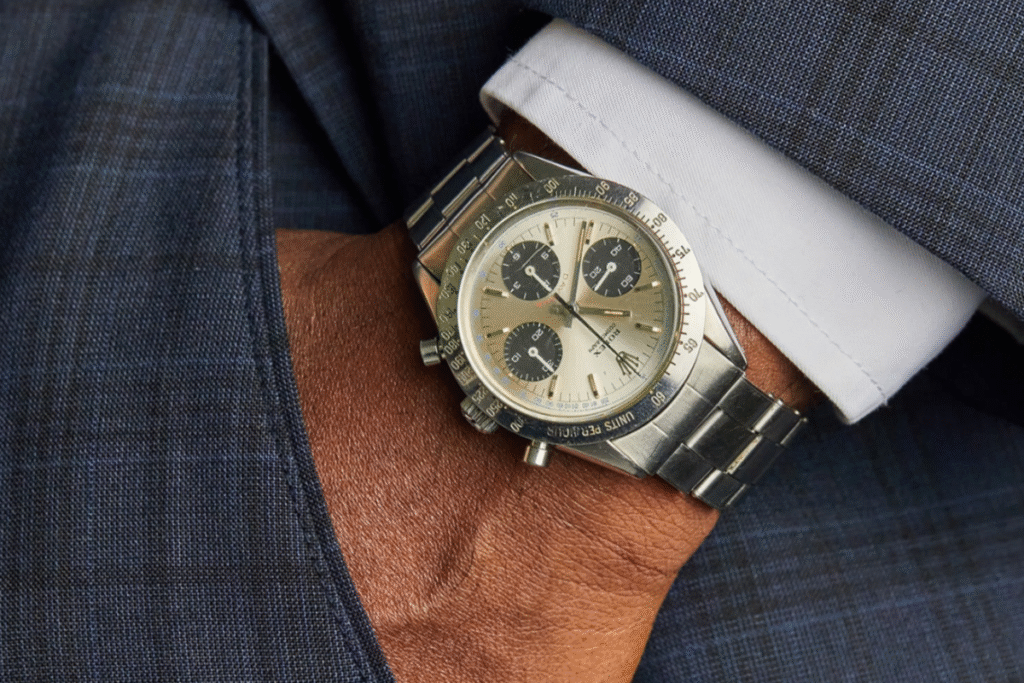
This makes Rolex not only the primary market leader, but also the clear benchmark in resale performance. Its dominance in both ecosystems reinforces its position as the industry’s liquidity anchor, the brand through which value, stability, and transactional confidence are most consistently measured.
The Big Houses in the Secondary Arena
Among the other major houses, Audemars Piguet delivered one of the strongest performances of the year, with total secondary-market sales value expanding by over 60% year-on-year, supported by rising volumes and stable median pricing.
Patek Philippe also performed strongly, with total secondary-market value exceeding 2.2 billion USD, up more than 40% year-on-year.
Vacheron Constantin emerged as one of the quieter winners of 2025, with sales value growing more than 70% year-on-year.
These numbers confirm that the ultra-high-end segment is not only resilient in the primary market, but highly dynamic in the secondary one.
Rolex Certified Pre-Owned: A Structural Turning Point
One of the clearest structural winners of the year was the Rolex Certified Pre-Owned program. Sales exceeded 590 million USD, representing more than 200% year-on-year growth and approximately 11% of total Rolex secondary-market value.
The impact extends beyond buyer confidence. Retailers benefit both from selling certified inventory and from acquiring supply through client trade-ins, effectively linking secondary liquidity to primary allocation access. This integration has accelerated turnover and inventory flow across the entire Rolex ecosystem.
The boundary between primary and secondary markets is becoming increasingly porous.
Market Share Comparison
When comparing secondary-market share with primary-market concentration, the parallels are striking.

Secondary market share:
- Rolex 36.8%
- Patek Philippe 14.4%
- Audemars Piguet 10%
- Omega 4.5%
- Richard Mille 4.2%
- Cartier 3.4%
Rolex’s dominance is even more pronounced in the secondary space than in the primary one. Meanwhile, Patek Philippe and Audemars Piguet significantly expand their relative weight when resale value becomes the metric.
Independent Brands Outperform
Independent brands delivered outsized growth, with total value sold reaching approximately 407.9 million USD, up 25.6% year-on-year, materially outpacing larger corporate groups on a percentage basis.
Collectors increasingly seek distinct identity, scarcity, and narrative depth, qualities often found in independent watchmaking.
Auctions: Cultural Barometer and Financial Indicator
Auctions generated 1.08 billion USD overall. The breakdown among leading brands highlights where collector intensity concentrates:
- Patek Philippe: 347 Million USD
- Rolex: 218 Million USD
- F.P. Journe: 72 Million USD
- Audemars Piguet: 67 Million USD
- Cartier: 52 Million USD
While auctions account for a smaller share of total transactions compared to dealer-driven sales, they remain a critical mechanism for price discovery and a cultural barometer of demand.
From Price-Led to Liquidity-Led Performance
The 2025 secondary market confirms a structural shift. Performance is no longer primarily price-led, but liquidity-led. The focus has moved from speculative spikes to speed of transaction, turnover efficiency, and capital fluidity.
For brands and collectors alike, 2025 establishes the secondary market not as a peripheral channel, but as a central system through which demand, value, and confidence are now measured.

If the primary market is defined by controlled scarcity and strategic pricing, the secondary market is defined by liquidity, transparency, and real-time valuation.
The question is no longer whether the secondary market matters.
It is whether it has become the industry’s most honest indicator of true demand.
Secondary market data:
EveryWatch Market Movement Report 2025
Primary market data:
Morgan Stanley x LuxeConsult Swiss Watch Industry Report 2025
Follow us on our social media channels to stay up to date with the latest news from the world of watchmaking, and discover what’s new on Watchype.
