

Cartier “Tutti Frutti” Platinum Bracelet Watch (circa 1930)
This exceptional Cartier platinum bracelet watch from around 1930 stands among the purest expressions of the Art Deco Tutti Frutti style. Created at a moment when jewellery and watchmaking were merging at the highest levels, the piece is remarkable for its vibrant composition of coloured gemstones and diamonds that wrap elegantly around both case and bracelet.
The watch features a rectangular dial signed Cartier, with classical Roman numerals and blued steel hands. This sits within a platinum case beautifully framed by calibré-cut emeralds, rubies and sapphires, interspersed with old-cut and baguette-cut diamonds. The bracelet extends the decorative language through an intricate openwork design, lavishly pavé-set with round and single-cut diamonds and punctuated by carved cabochon emerald and ruby beads. The collective effect is a deliberate riot of colour and texture, emblematic of Cartier’s Indian-inspired aesthetic during the period. Typical of the Tutti Frutti approach, the coloured stones were chosen for dramatic hue and presence rather than strict clarity, resulting in a luminous interplay of deep reds, vivid greens and rich blues against platinum’s cool sheen.
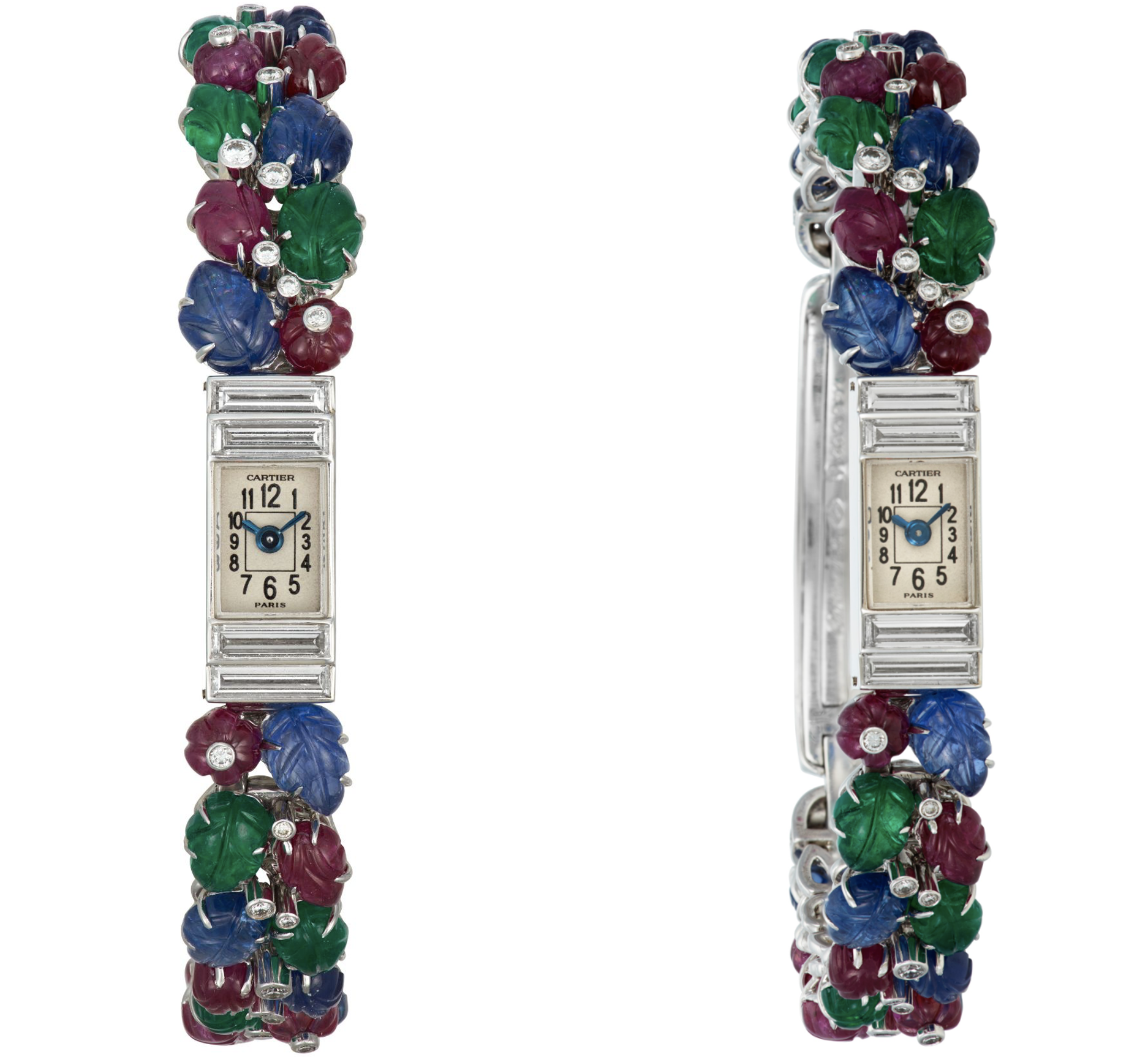
The Tutti Frutti style was developed by Cartier following Jacques Cartier’s travels in India, where he was inspired by the carved gemstones and Mughal ornamental traditions then admired by princely clients. Gemstones carved as leaves, berries and floral motifs were combined with diamonds to create compositions that prioritised visual impact and movement, a sensibility that this watch exemplifies.
By the early 1930s, designs of this nature had found favour with society figures and style icons who embraced the fusion of Eastern ornamentation with Western modernity. Its interplay of light, colour and texture transforms it into a miniature jewel sculpture as much as a wristwatch, capturing the exuberance and cosmopolitan glamour of the Art Deco era.
Surviving examples of Cartier’s Tutti Frutti wristwatches are exceptionally rare. One notable example featuring carved rubies, sapphires and emeralds set with round and baguette-cut diamonds in platinum and 18k white gold, was offered from a distinguished private collection and sold at Christie’s for US$425,000, significantly above its pre-sale estimate. This result reflects both the intrinsic worth of its precious materials and the piece’s significance as an artefact of interwar luxury and design innovation. Such watches today occupy a special place in the market: treasured not only for their gem-set splendour but also as historic objets d’art that epitomise the Jazz Age fusion of high jewellery and horology.
Van Cleef & Arpels “Cadenas” Diamond Wristwatch (1935)
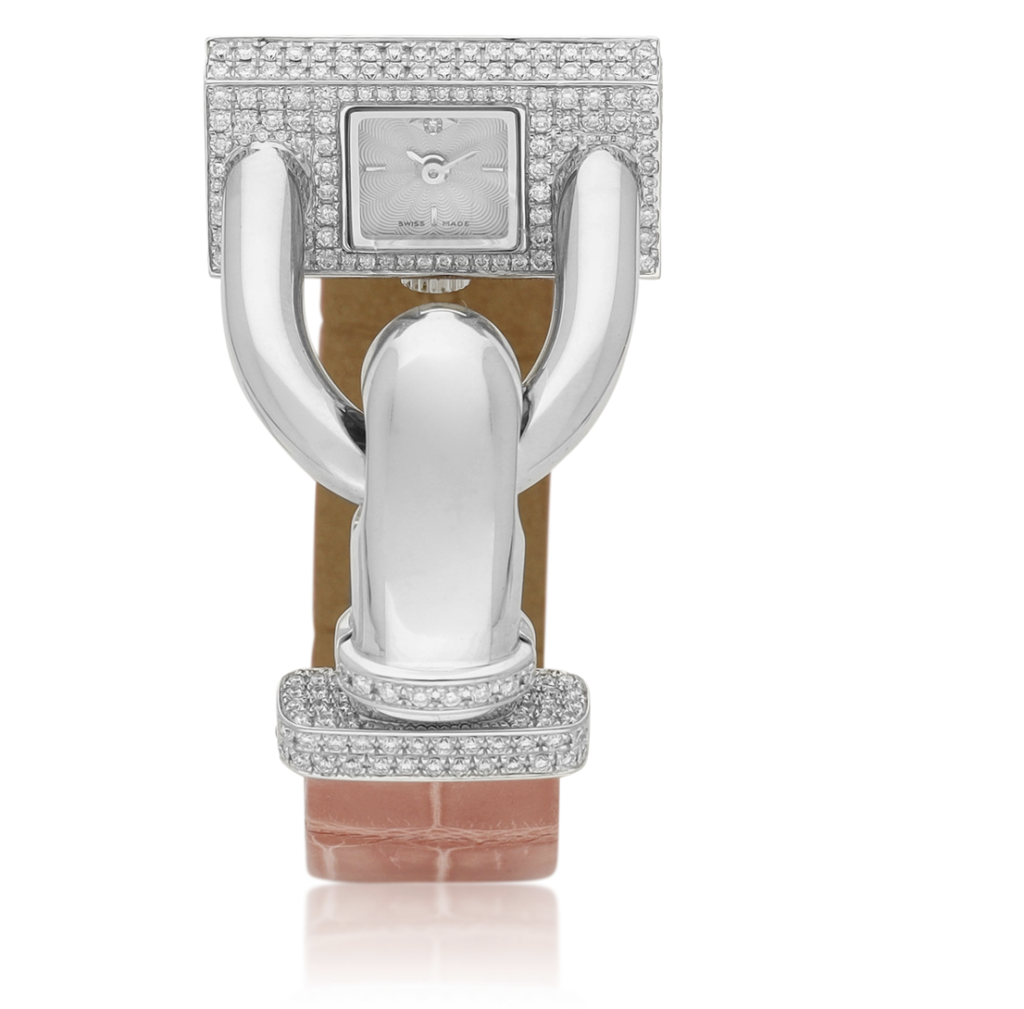
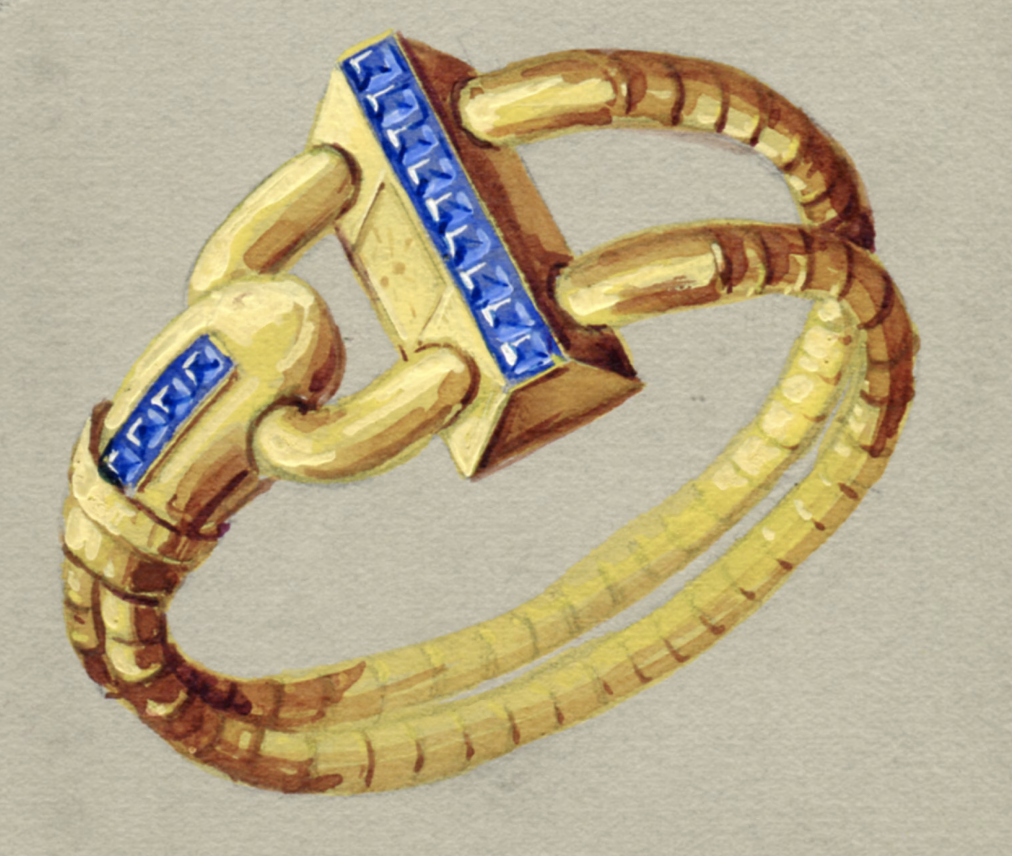
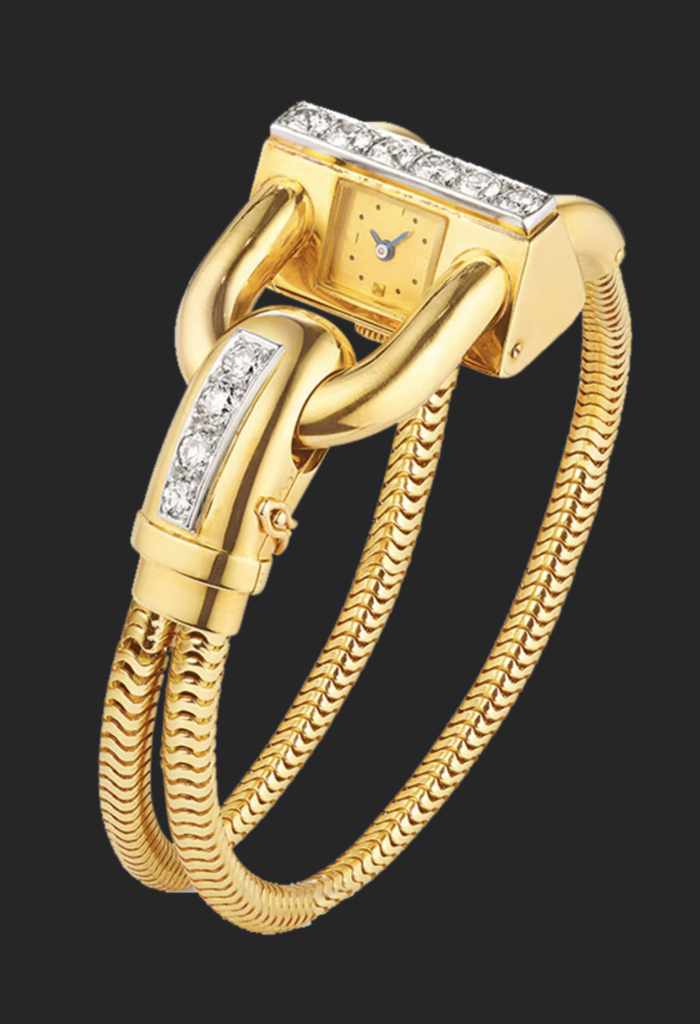
Introduced in 1935, the Van Cleef & Arpels Cadenas stands as one of the most intellectually refined and aesthetically distinctive wristwatches of the Art Deco period. Its padlock-inspired form was conceived as an elegant response to contemporary social etiquette, at a time when overtly checking the time was considered unseemly for women. The design features a looped, half-hoop case resembling a padlock, with a discreetly angled dial positioned so that it is legible only to the wearer.

The geometry of the Cadenas is unmistakably modern, combining clean architectural lines with sculptural curves. Early examples were produced in precious metals such as yellow gold, but the most celebrated and valuable versions were executed in platinum or white gold and entirely set with diamonds for elite clients. In these high jewellery interpretations, the watch transcended its functional purpose and became a couture object.
The most famous Cadenas wristwatch belonged to the Duchess of Windsor. Executed in platinum and set with approximately eight carats of diamonds, the piece featured a sophisticated mix of brilliant and baguette-cut stones across the case and bracelet. The dial itself was intentionally understated, marked only by minimal indicators so as not to disturb the jewel-like continuity of the design. The bracelet, often realised as a double snake-chain, exemplified Van Cleef & Arpels’ exceptional mastery of gem-setting and fluid construction.
Beyond its formal innovation, the padlock motif carried deep symbolic resonance. It evoked secrecy, devotion and commitment, themes particularly poignant in the context of the Duchess and Duke of Windsor, who reportedly embraced the padlock as a private emblem of their relationship. Artistically, the Cadenas embodies core Art Deco ideals: ornament rooted in function, bold abstraction balanced by elegance, and technical ingenuity rendered almost invisible beneath luxurious simplicity.
From a market perspective, vintage Cadenas watches rank among the most coveted creations of Van Cleef & Arpels. The Duchess of Windsor’s diamond-set example achieved an exceptional result at auction, selling for approximately CHF 360,000, and now resides within the maison’s Heritage Collection. Early diamond-set models from the late 1930s routinely command high six-figure prices, while original gold examples typically trade in the 120,000 to 250,000 euros range depending on condition, provenance and gem-setting.
The enduring desirability of the design has led Van Cleef & Arpels to reissue the Cadenas in modern collections, including diamond-set white gold versions produced in the 21st century, which retail and trade on the secondary market at substantial premiums. However, collectors continue to prize the original Art Deco examples most highly, valuing their direct connection to 1930s high society and the radical elegance of the original concept.
Audemars Piguet Art Deco Gem-Set Bracelet Watch (circa 1933)
During the interwar period, even the most traditional Swiss watchmakers explored the realm of high jewellery, and Audemars Piguet produced some of the era’s most ambitious gem set wristwatches. This Art Deco bracelet watch from around 1933 represents an extraordinary fusion of fine watchmaking and jewelled artistry, and exemplifies the creative audacity of the period.
Executed primarily in platinum with touches of 18k white gold, the timepiece features a small, elegantly proportioned rectangular dial with blued steel hands and abstract Art Deco chapters. The dial is framed by a radiant border of circular and baguette cut diamonds and accented with rectangular cut emeralds at its corners, introducing a refined contrast of colour and geometry. Flowing seamlessly from the case is a wide bracelet composed of sculptural clusters of coloured gems. Carved sapphire, ruby and emerald leaves and berries are interspersed among pavé set diamonds, including single, circular and marquise cuts, together with circular cut yellow diamonds that introduce a subtle chromatic warmth to the predominantly cool toned palette.
The design closely echoes the Tutti Frutti aesthetic popularised by Cartier in the same decade, favouring carved gemstones, bold multicolour compositions and tactile depth. Platinum, the metal most favoured by Art Deco jewellers for its strength and luminous sheen, provides both structural integrity and a bright backdrop against which the richly coloured stones come alive. Old mine and old European cut diamonds are distributed throughout, their soft, diffuse sparkle complementing the more vivid hues of the coloured gems, while the occasional yellow diamond adds a nuanced warmth to the overall harmony.
Technically, the watch houses a high grade, 18 jewel manual winding lever movement signed by Audemars Piguet. Archival records confirm that this movement was manufactured and subsequently sold to the Parisian jeweller Carasset Madon on 5 December 1933, strongly suggesting that the completed watch was a bespoke commission for a discerning client.
Each link of the bracelet can be appreciated as a tiny work of exotic jewellery art, comparable to a miniature gem set brooch, while the integration of the dial into this ornamental ensemble is handled with rare subtlety so as not to interrupt the visual rhythm of the design. Such gem set wristwatches by Audemars Piguet are exceedingly rare, far scarcer than comparable creations by the great jewellery houses, and when examples do surface at auction they attract attention not only for the intrinsic value of their gemstones and metals but also for their cultural and artistic significance.
One notable example of this Audemars Piguet Art Deco gem set bracelet watch appeared at Christie’s in the Magnificent Jewels sale in April 2002. Offered from the estate of a private lady, it realised US$41,125, well above its pre sale estimate, underscoring the strong market interest in rare early twentieth century jewelled timepieces and the enduring appeal of this extraordinary fusion of horology and haute joaillerie.
This watch embodies the exuberance of the early 1930s, a moment when boundaries between craft disciplines dissolved and luxury was expressed as much through imaginative design as through technical achievement. As an object, it stands at the intersection of fine watchmaking and high jewellery, a glittering testament to the creative freedom of the Art Deco era and the refined excess of the Jazz Age.
Follow us on our social media channels to stay up to date with the latest news from the world of watchmaking, and discover what’s new on Watchype.
